The walk to Everest Base Camp is the most famous trek on earth, and it deserves the reputation. Fourteen days gives you the classic route through the Khumbu with the acclimatisation days that make it safe, finishing at the glacier camp itself and the sunrise viewpoint on Kala Patthar.
We run this trek with Sherpa guides who grew up in these valleys, and we build in the rest days rather than selling a compressed schedule that puts you at risk.
Trip Highlights
- Everest Base Camp (5,364m) at the foot of the Khumbu Icefall
- Sunrise from Kala Patthar (5,545m), the classic Everest viewpoint
- Namche Bazaar, the trading heart of the Sherpa homeland
- Tengboche Monastery with Ama Dablam behind it
- Two full acclimatisation days built into the schedule
- The spectacular mountain flight in and out of Lukla
Overview
The walk to Everest Base Camp is the most famous trek on earth, and it deserves the reputation. Fourteen days gives you the classic route through the Khumbu with the acclimatisation days that make it safe, finishing at the glacier camp itself and the sunrise viewpoint on Kala Patthar.
We run this trek with Sherpa guides who grew up in these valleys, and we build in the rest days rather than selling a compressed schedule that puts you at risk.
Trip Highlights
- Everest Base Camp (5,364m) at the foot of the Khumbu Icefall
- Sunrise from Kala Patthar (5,545m), the classic Everest viewpoint
- Namche Bazaar, the trading heart of the Sherpa homeland
- Tengboche Monastery with Ama Dablam behind it
- Two full acclimatisation days built into the schedule
- The spectacular mountain flight in and out of Lukla
Trip Highlights
- Everest Base Camp (5,364m) at the foot of the Khumbu Icefall
- Sunrise from Kala Patthar (5,545m), the classic Everest viewpoint
- Namche Bazaar, the trading heart of the Sherpa homeland
- Tengboche Monastery with Ama Dablam behind it
- Two full acclimatisation days built into the schedule
- The spectacular mountain flight in and out of Lukla
Itinerary of Everest Base Camp Trek – 14 Days
You are met at Tribhuvan International Airport and transferred to your hotel in Kathmandu at 1,400 m. Depending on your arrival time the rest of the day is free to rest or to walk into Thamel, the warren of streets that has outfitted Himalayan expeditions since the 1970s.
In the late afternoon your guide holds the pre-trek briefing. This covers the day-by-day route, expected conditions, altitude and how we manage it, and the kit you will need at each stage. It is the moment to raise anything you are unsure about.
Permits are processed at this point, so bring your passport and travel insurance documents. Insurance covering trekking to 6,000 m including helicopter evacuation is a firm requirement for this route, not a formality.
Any gear you still need can be bought or hired in Thamel, where a good down jacket, sleeping bag and duffel are readily available. Your guide will come with you if you would like a second opinion on quality.
Overnight in a three-star hotel in Kathmandu.
A very early transfer to the domestic terminal for the flight to Lukla. The thirty-five minute flight is one of the most dramatic short hops anywhere, threading between hills before landing uphill on the short runway at Tenzing-Hillary Airport at 2,860 m. In the peak months of spring and autumn flights operate from Ramechhap instead, which means a road transfer leaving Kathmandu around one in the morning.
At Lukla you meet the porters over tea while loads are weighed and distributed, then walk out through the town gate onto the main Khumbu trail.
The day's walking is deliberately easy and mostly downhill, following the Dudh Koshi through Chheplung and Ghat. You pass your first mani walls and prayer wheels turned by the stream, and the rule of walking to the left of them is worth learning now.
The river below runs a startling milky grey with glacial silt, which is exactly what its name - milk river - describes. Around three hours of walking over 8 km, descending some 250 m.
Lunch and dinner at the lodge. Overnight in Phakding.
The trail continues up the Dudh Koshi, crossing and recrossing the river on high suspension bridges hung with prayer flags. At Monjo you register at the entrance to Sagarmatha National Park, a UNESCO World Heritage site, then drop to Jorsalle for lunch.
Beyond Jorsalle is the Hillary Bridge, the highest and longest of the crossings, strung dizzyingly above the confluence of the Dudh Koshi and Bhote Koshi. From its far side the day's real work begins.
The Namche hill climbs some 600 m through pine forest in a long series of switchbacks, taking two to three hours at a steady pace. Around halfway up, weather permitting, there is a first view of Everest - a dark pyramid behind the Nuptse-Lhotse wall - which is the traditional reward.
Namche Bazaar appears abruptly, built in a natural horseshoe bowl facing Kongde Ri: lodges, bakeries, gear shops and a Saturday market that has served Sherpa and Tibetan traders for generations. At 3,440 m it is the largest settlement in the Khumbu and the hub of the whole region.
Six to seven hours of walking over 11 km with around 830 m of ascent. All meals provided. Overnight in Namche.
The first scheduled acclimatisation day, and not one spent lying down. Climbing several hundred metres and returning to sleep low is far more effective than resting, so the morning is given to a walk above the town.
The route climbs steeply behind Namche past the Syangboche airstrip to the Everest View Hotel at 3,880 m. From its terrace, over a pot of tea, Everest, Lhotse, Nuptse and Ama Dablam stand in a single line - one of the great mountain views reachable on foot in a morning.
From there the walk loops down through Khumjung, the largest Sherpa village in the area with its distinctive green roofs and a monastery said to hold a yeti scalp, and Khunde with the hospital Edmund Hillary founded in 1966, before returning to Namche.
The afternoon is free. The Sherpa Culture Museum and the national park visitor centre above the town are both worth an hour, and Namche has the last reliable ATMs, bakeries and hot showers of the trek.
Four to five hours of easy walking, 440 m gained and lost. All meals provided. Overnight in Namche.
One of the classic days of Khumbu walking. The trail climbs out of Namche and then runs level along the valley wall on a broad contour path, with Everest, Lhotse, Nuptse, Thamserku and the extraordinary spire of Ama Dablam directly ahead for most of the morning.
At Kyangjuma the path forks - the right branch heads for Gokyo - and you descend steeply to Phunki Tenga on the Dudh Koshi, a small settlement where water-driven prayer wheels turn in the stream. Lunch is usually taken here.
The afternoon is a sustained 600 m climb through rhododendron and birch forest to the saddle at Tengboche. It is a hard ninety minutes, but the arrival is remarkable: a broad grassy shoulder holding the largest monastery in the Khumbu, framed by Everest and Ama Dablam.
If the timing works you can sit in on the late afternoon prayer ceremony, with horns, drums and chanting - visitors are welcome to sit quietly at the back. Photography inside is usually not permitted.
Five to six hours over 10 km with roughly 700 m of ascent. All meals provided. Overnight in Tengboche.
Wake early if you can - sunrise at Tengboche lights Everest, Lhotse, Nuptse and Ama Dablam in sequence and is, on a clear morning, among the finest views of the trek.
After breakfast the trail descends through rhododendron forest to Deboche, crosses the Imja Khola on a bridge high above a gorge, and climbs to Pangboche at 3,930 m. The gompa here is the oldest in the Khumbu and is worth the short detour up into the upper village.
Above Pangboche the treeline is left behind for good. The valley opens into the wide, bare Imja basin, and the walking becomes a steady climb across open hillside with Ama Dablam looming to the right and Island Peak visible at the head of the valley.
Dingboche at 4,410 m is a scattered settlement of stone-walled potato and barley fields, remarkable for being farmed at this altitude at all. The stone walls are built to shelter crops from the wind.
Five to six hours over 12 km with around 550 m of ascent. All meals provided. Overnight in Dingboche.
The second and more important acclimatisation day. You are now above 4,400 m, and how well you use today largely determines how the next four days go.
The standard walk is the climb up Nangkartshang Ridge behind the village, a steep but non-technical ascent of some 600 m to a prayer-flag-covered high point at around 5,080 m. It takes three to four hours up and back.
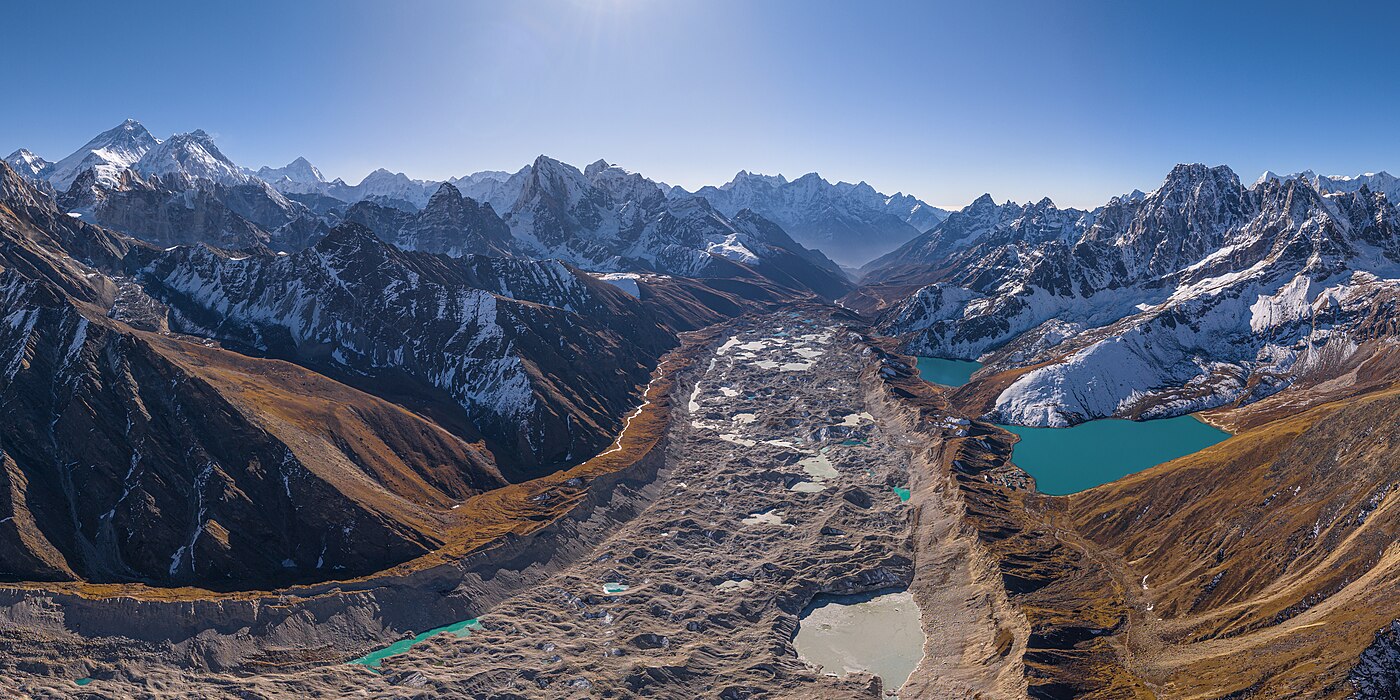
The view from the ridge is exceptional and quite different from anything lower down: Makalu, the world's fifth highest peak, appears to the east, with Ama Dablam directly opposite, Lhotse and Island Peak at the head of the Imja valley, and Taboche and Cholatse to the west.
Back in Dingboche the afternoon is free. Drink three to four litres through the day, eat properly even without much appetite, and tell your guide about any headache, nausea or unusual breathlessness. There is no advantage in pushing on if you are not adjusting - your guide will make that call with you.
Three to four hours of walking, around 600 m gained and lost. All meals provided. Overnight in Dingboche.
The trail climbs gently out of Dingboche onto the ridge above the village and contours north into the Khumbu valley proper, joining the main route from Pheriche at Dughla.
From Dughla comes a short steep climb of about an hour up the terminal moraine of the Khumbu Glacier to Thukla Pass at 4,830 m. The top of the climb opens onto a field of stone memorials and chortens commemorating climbers who died on Everest, among them Scott Fischer and Babu Chiri Sherpa. It is a quiet and rather affecting place, and most people slow down here.
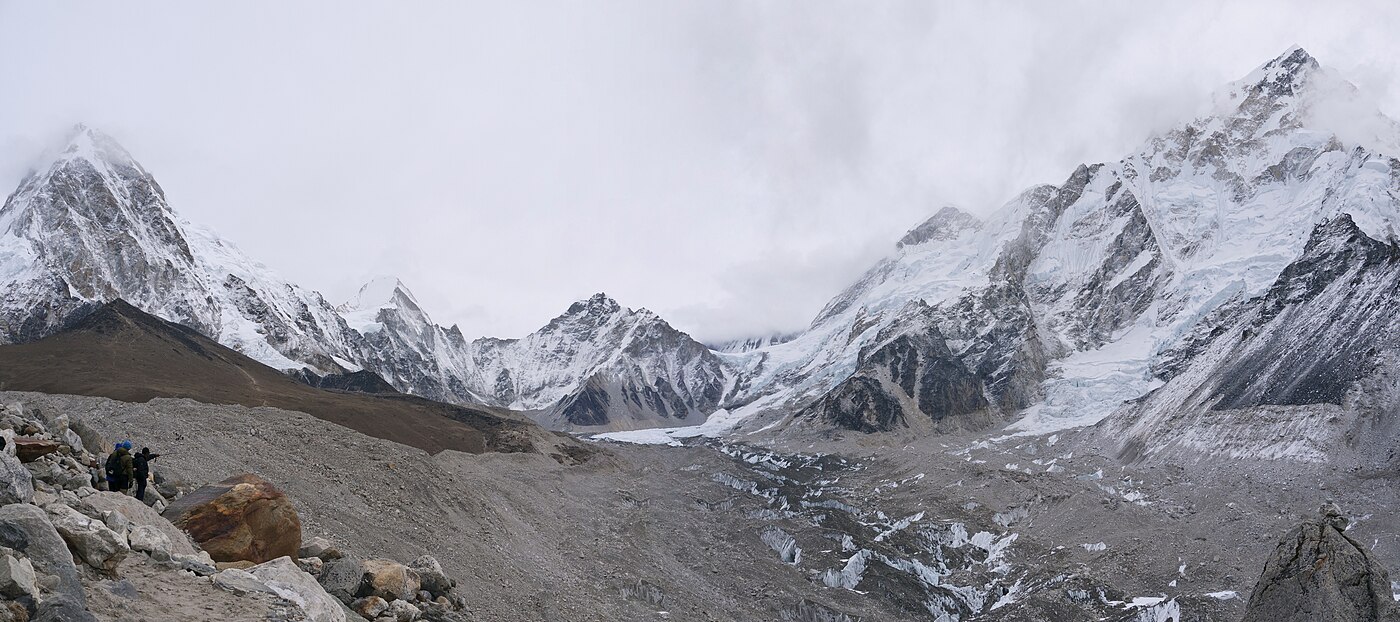
Beyond the memorials the trail follows the lateral moraine of the glacier, an increasingly stark landscape of rock, ice and scree with Pumori ahead and Nuptse rising to the right.
Lobuche at 4,940 m is a small line of lodges in an exposed spot. Nights here are cold and sleep is often broken; this is normal at this altitude.
Five to six hours over 8 km with around 530 m of ascent. All meals provided. Overnight in Lobuche.
The longest and highest day of the trek, and the reason you came. An early start follows the rough moraine trail beside the Khumbu Glacier, crossing boulder fields and glacial streams where the path is never quite the same twice as the ice shifts beneath it.
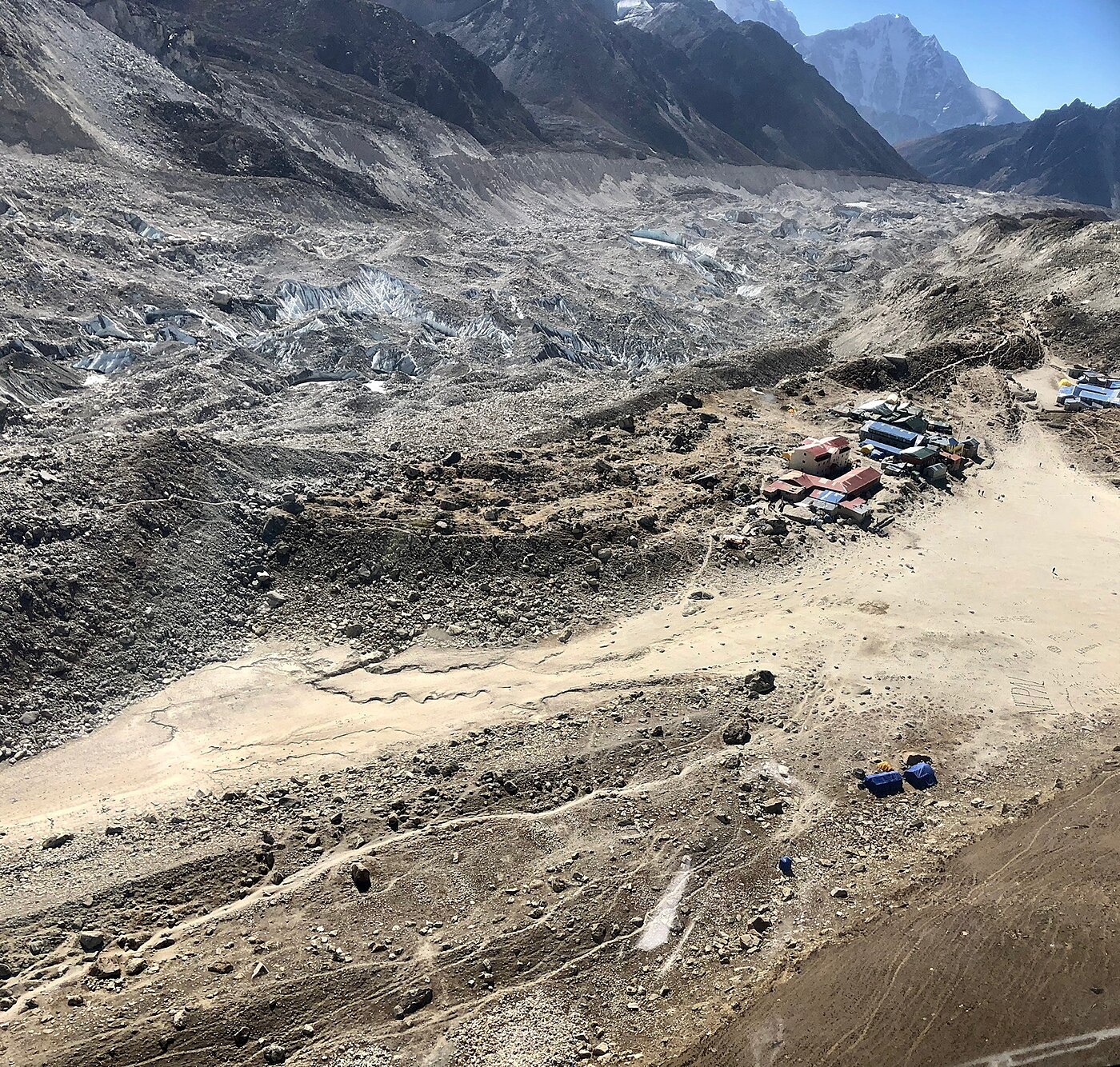
Around three hours brings you to Gorak Shep at 5,164 m, a handful of lodges on the sandy bed of a drained glacial lake, where you drop your day pack and take an early lunch.
The afternoon push to Everest Base Camp takes a further two to three hours over rock and moraine, gaining height slowly. Base Camp at 5,364 m sits directly beneath the Khumbu Icefall - a chaos of tumbling seracs pouring off the Western Cwm - with Nuptse and Pumori above. In April and May it is a small city of tents; outside the climbing season it is bare ice and rock, and quieter for it.
Everest itself is not visible from Base Camp, being hidden behind Nuptse, which surprises many people. That view comes tomorrow. You return to Gorak Shep to sleep.
Seven to eight hours in total over 15 km, with around 420 m of net ascent at very thin air. All meals provided. Overnight at Gorak Shep.
A pre-dawn start in the cold for the climb to Kala Patthar at 5,545 m, the highest point of the trek. The ascent is steep, on rock and scree, and takes two to three hours - slow going at this altitude, but no technical difficulty.
The summit gives the definitive view of Everest: the entire south-west face from base to summit, with the plume of spindrift usually streaming off the top, flanked by Nuptse, Lhotse, Changtse and Pumori directly overhead. For most people this, rather than Base Camp itself, is the high point of the whole journey.
You descend to Gorak Shep for breakfast, then begin the long walk down, retracing the moraine to Lobuche and over Thukla Pass before dropping into the Pheriche valley.
Pheriche at 4,240 m is home to the Himalayan Rescue Association aid post, staffed by volunteer doctors through the trekking seasons. The extra 700 m of descent from Lobuche makes a noticeable difference to how well you sleep tonight.
Seven to eight hours in total, with 600 m of ascent and around 1,300 m of descent. All meals provided. Overnight in Pheriche.
A long descending day back into thicker air and, gradually, vegetation. The trail follows the Imja Khola down the valley, rejoining the outward route below Pangboche and dropping through Deboche to the river crossing.
The climb back up to Tengboche is short but feels harder than expected; after that it is downhill through the forest to Phunki Tenga, then a steady climb back onto the high contour path at Sanasa.
The change in the air is striking. Juniper and rhododendron reappear, then birch and pine, and by afternoon the landscape is green again after days of rock and ice. Appetite usually returns sharply somewhere around here.
The last stretch traverses back into Namche with the Kongde wall opposite. Arriving in the afternoon, there is a hot shower, a bakery and a proper menu waiting.
Six to seven hours over 20 km, descending around 800 m. All meals provided. Overnight in Namche.
The final full day of walking, dropping steeply out of Namche to the Hillary Bridge - much easier in this direction - then following the Dudh Koshi downstream through Jorsalle and Monjo, where you sign out of the national park.
The valley narrows and greens as you lose height, with pine forest and cultivated terraces replacing the open hillsides above Namche.
From Phakding the trail undulates rather than descends, and the several short climbs through Ghat and Chheplung feel disproportionately hard at the end of a long day and a long trek. The final pull up into Lukla is the last of it.
The evening in Lukla is traditionally spent with the guides and porters over dinner, and it is the customary point at which tips are given. Your guide can advise on what is usual.
Six to seven hours over 19 km with around 850 m of descent and 300 m of ascent. All meals provided. Overnight in Lukla.
Mountain flights leave early, before the valley wind gets up, so you transfer to the airport shortly after breakfast for the thirty-five minute flight to Kathmandu - or to Ramechhap with a road transfer onwards, depending on the season.
Lukla flights are genuinely weather-dependent and delays of several hours, or occasionally a full day, are a normal part of trekking in this region. This is exactly why we recommend keeping at least one buffer day in Kathmandu before any international flight; if the weather closes in entirely, a helicopter transfer can usually be arranged at additional cost.
On arrival you are met and transferred to your hotel. The rest of the day is free, and most people head straight for a long hot shower.
In the evening there is a farewell dinner at a Nepali restaurant in the city, usually with music and dance, to mark the end of the trek.
Breakfast and dinner provided. Overnight in Kathmandu.
The trip ends today. Depending on your flight time there may be a free morning for last-minute shopping in Thamel - Namche and Kathmandu prices for pashmina, singing bowls and Tibetan crafts differ considerably, and Kathmandu wins.
If you have a late flight, day-use of a hotel room can be arranged so you have somewhere to shower and repack rather than waiting at the airport.
You are transferred to Tribhuvan International Airport approximately three hours before your scheduled departure. International check-in at Kathmandu can be slow, so we do not cut this fine.
If you are extending your stay in Nepal - Chitwan, Pokhara, Lumbini or a rafting trip are all easy add-ons from here - we are glad to arrange it, and it is best raised before the trek rather than after.
Breakfast provided.
Cost Includes/Excludes
Cost Includes
- Airport transfers and three nights hotel in Kathmandu with breakfast
- Kathmandu to Lukla return flights including airport taxes
- Ten nights teahouse accommodation on a twin-sharing basis
- All meals during the trek: breakfast, lunch and dinner
- Government-licensed English-speaking Sherpa guide
- One porter shared between two trekkers (up to 20kg)
- Sagarmatha National Park and Khumbu Pasang Lhamu permits
- Guide and porter wages, insurance, meals and accommodation
- First aid kit and pulse oximeter carried by the guide
- Duffel bag, down jacket and sleeping bag on loan
- All applicable government taxes
Cost Excludes
- International flights and Nepal visa fees
- Lunch and dinner in Kathmandu
- Travel and medical insurance with cover to 5,600m including helicopter evacuation
- Personal trekking equipment and clothing
- Drinks, hot showers, Wi-Fi and charging on the trail
- Extra nights and costs caused by Lukla flight delays
- Tips for guide and porter
FAQs
The two acclimatisation days at Namche and Dingboche are what keep the trek safe. Operators selling 10 or 11-day versions cut those days, which sharply raises the risk of altitude sickness and of not completing the trek at all.
Not the summit. Base Camp sits beneath the Khumbu Icefall with Everest hidden behind Nuptse. That is why the itinerary includes Kala Patthar, where the classic Everest view is taken.
You should be able to walk five to seven hours a day for several consecutive days. There is no technical ground. Hill walking and stair training in the months before you travel makes a substantial difference.
Delays are common in any season. We recommend keeping at least two spare days before your international flight. Helicopter transfers can usually be arranged at extra cost if you are short of time.