Overview
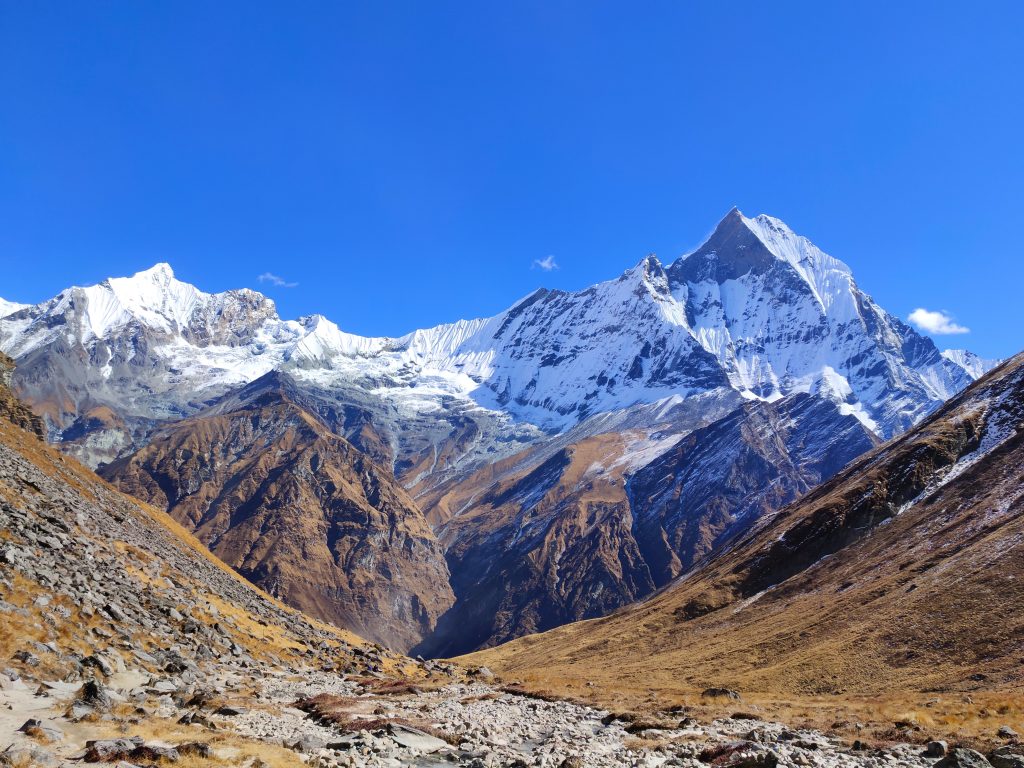
The Annapurna Base Camp Trek is one of the most iconic journeys in Nepal’s Annapurna region, leading trekkers into the breathtaking Annapurna Sanctuary—a natural amphitheater encircled by towering peaks such as Annapurna I (8,091 m), Machhapuchhre, Annapurna South, Hiunchuli, and Gangapurna.
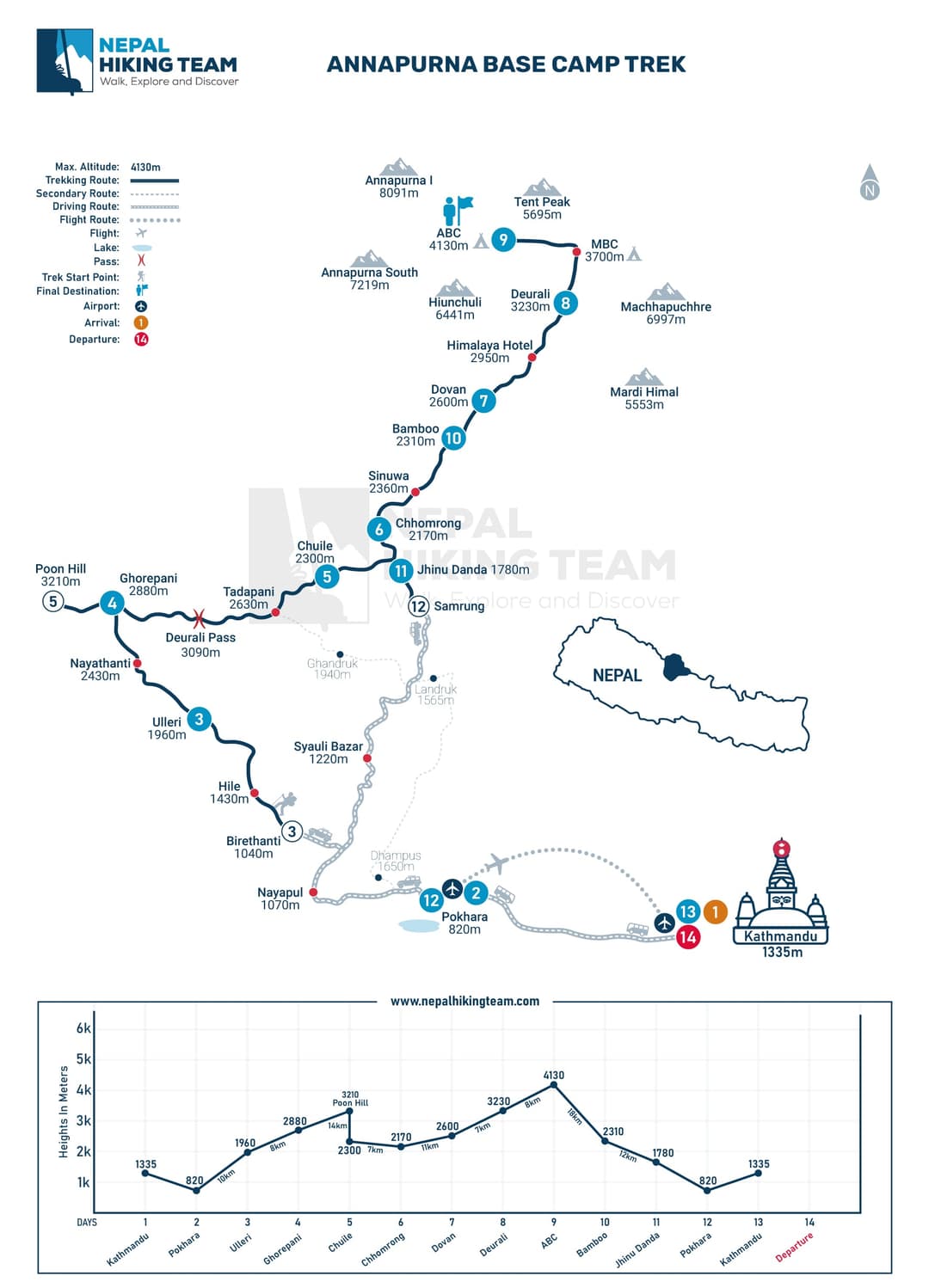
This classic 14-day trek begins in terraced farmlands and lush forested hills, gradually ascending into alpine landscapes before reaching Annapurna Base Camp at 4,130 meters. The route via Ghorepani Poon Hill adds a highlight experience, offering spectacular sunrise views over the Annapurna and Dhaulagiri ranges.
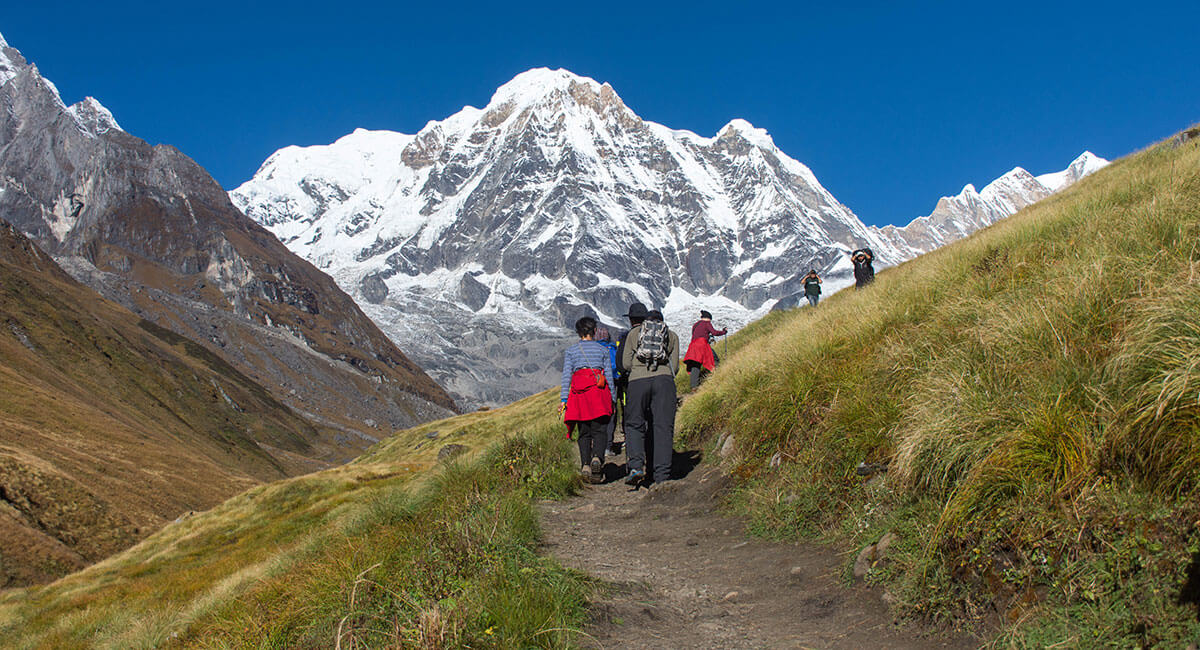
Graded as moderate, the trek involves steady altitude gain with daily walks of 4 to 7 hours. While it does not require technical climbing, the trail includes a mix of stone staircases, suspension bridges, forest paths, and high mountain terrain, making it both accessible and diverse. With basic preparation and a reasonable level of fitness, it is suitable for first-time high-altitude trekkers while still rewarding for experienced hikers.
The best times to undertake the Annapurna Base Camp Trek are from March to May and September to November, when weather conditions are stable, skies are clear, and mountain views are at their best.
Trekkers must obtain the necessary permits, including the Annapurna Conservation Area Permit (ACAP), as the entire route lies within the protected Annapurna Conservation Area—Nepal’s largest conservation area.
Itinerary of Annapurna Base Camp Trek
Upon arrival at Tribhuvan International Airport, you will be welcomed and transferred to your hotel in Kathmandu.
At the hotel, a pre-trek briefing will be held to introduce your guide and provide a detailed overview of the Annapurna Base Camp (ABC) trek. This session typically covers the trail route, expected weather conditions, safety guidelines, and overall logistics to ensure you are well prepared for the journey.
You will be provided with essential trekking gear, including a duffel bag, a warm down jacket (rated to -15°C), and a sleeping bag (rated to -20°C), along with a trekking map of the Annapurna region and a few complimentary items.
Copies of your passport and travel insurance (if not already submitted) will be collected for permit processing and safety documentation, along with any remaining trip formalities.
After the briefing, the rest of the day is free for you to relax, explore the city, or make final preparations for the trek.
Overnight stay at Woodapple Hotel and Spa or a similar-category hotel in Kathmandu.
On the second day, your guide meets you at the hotel early in the morning (usually at 6:30 am) and escorts you to the tourist bus terminal for the overland journey to Pokhara.
The journey follows the Prithvi Highway through river valleys, terraced hillsides, forested slopes, and rural settlements, creating a gradual transition from the capital to Pokhara. After a 6- to 7-hour drive, you will arrive in Pokhara in the mid- to late afternoon.
Upon arrival, your guide will assist with hotel check-in. The remainder of the day is kept light with an optional walk around Lakeside. This allows you to rest, recover from road travel, and prepare for the start of the trek.
Prithvi Highway is currently undergoing a four-lane expansion, with the Mugling-Pokhara section largely paved and widening works underway. Construction between Naubise and Mugling may result in occasional traffic delays.
Stay at Hotel Hidden Kingdom or a similar category hotel, subject to availability.
Around 7:00 in the morning, after breakfast, we begin our overland transfer to Hile, the starting point of the Annapurna Base Camp trek.
The ACAP is checked at Birenthanti.
From Hile, the trail ascends steadily on established stone paths toward Ulleri. This short but continuous climb marks the first sustained ascent of the Annapurna Base Camp Trek and sets the walking rhythm for the days ahead. Although the distance is relatively short, the trail's moderate uphill grade requires steady pacing.
The route follows well-maintained footpaths through terraced farmland and hillside landscapes. On clear days, Annapurna South first becomes visible from Ulleri, offering a rewarding introduction to the Himalayan scenery. An overnight stay has been arranged at a carefully selected teahouse in Ulleri.
Stay at New Annapurna Hotel in Ulleri Village.
The day begins with a steady ascent from Ulleri toward Ghorepani, following forested mountain trails through one of the most scenic sections of the lower Annapurna region.
The route climbs gradually through dense rhododendron forests, especially vibrant in spring, with well-defined stone paths and shaded walking throughout the day.
Along the way, the trail passes through Banthanti (around 2,250 m) and Nangethanti (around 2,520 m), which serve as traditional rest stops with teahouses rather than full villages. These points provide natural breaks for lunch and acclimatization before the final climb toward Ghorepani.
The section is rated moderate in difficulty, with consistent uphill walking rather than steep or technical terrain.
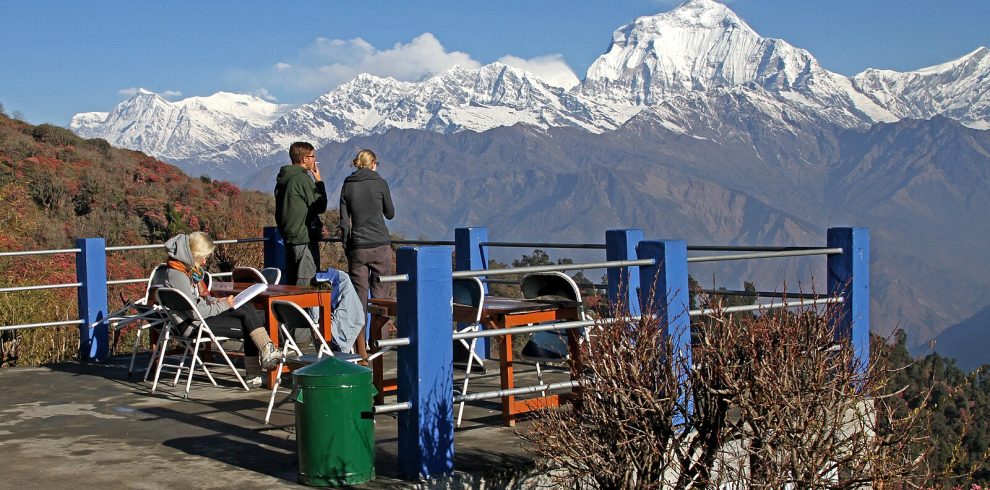
On clear afternoons, views toward Annapurna South, Hiunchuli, and Machhapuchhre open up from around the village, while clear views of Dhaulagiri are typically reserved for the following morning’s hike to Poon Hill.
Upon arrival, time is available to rest and prepare for the early-morning ascent to Poon Hill the next day.
Stay at Hungry Eye Lodge in Ghorepani or similar, depending on availability.
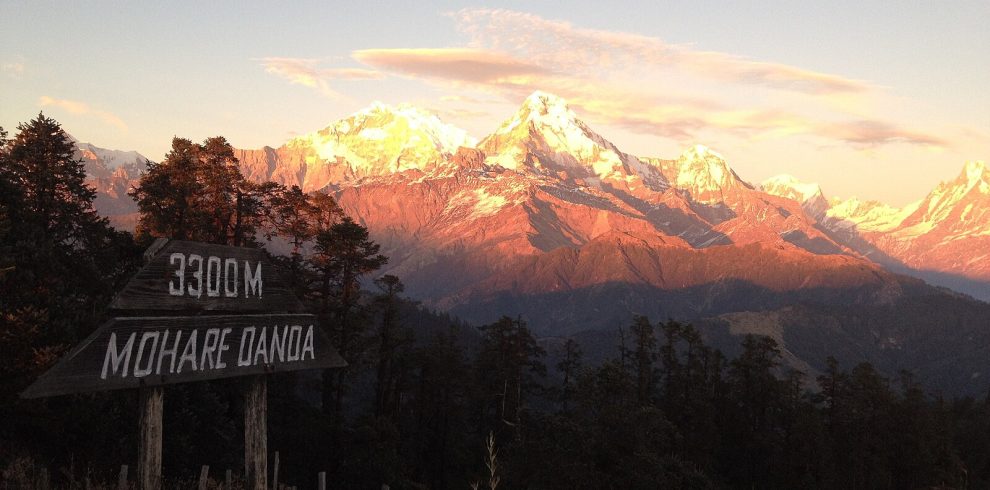
The day begins early with a 45 to 60-minute ascent from Ghorepani to Poon Hill, reaching 3,210 meters in time for sunrise. Morning conditions are often cold, particularly in winter, and the climb is steady rather than technical. From the viewpoint, clear-weather panoramas extend across the Annapurna range, with reliable views of Dhaulagiri, Annapurna South, Hiunchuli, and Machhapuchhre.
Ghorepani Poon Hill is one of the most iconic highlights along the Annapurna Base Camp trek
After descending back to Ghorepani for breakfast, the trek continues eastward through dense forest trails toward Tadapani. The route crosses Deurali Pass at approximately 3,090 meters, followed by a long descent through rhododendron-covered slopes and shaded woodland paths. This section is predominantly forested, with limited interaction with settlements along the way.
The trail passes through Banthanti, a small lodge cluster located around 2,600 to 2,700 meters, before continuing toward the Tadapani ridge.
Rather than stopping at Tadapani, the route descends slightly to Chuile, where overnight accommodation is arranged. Due to multiple ascents and descents throughout the day, this section is considered moderately demanding despite the absence of technical terrain.
Stay at Rainbow Hotel in Chuile or similar, depending on availability.
The trek from Chuile to Chhomrong is a demanding but rewarding day, defined by significant elevation loss followed by a sustained climb. The trail first descends steeply through forested slopes toward the Kimrong Khola.
After crossing the suspension bridge over the Kimrong Khola, the trail climbs steadily and steeply toward Chhomrong. This ascent involves long stretches of stone staircases and requires steady pacing rather than speed. Although the overall distance is moderate, the repeated descent and ascent make this day physically challenging.
Chhomrong is widely regarded as the main gateway village to the Annapurna Sanctuary and is the largest permanent Gurung settlement on the route.
Beyond Chommrong, meat availability becomes increasingly limited and is generally discouraged in teahouses as the trail enters higher, more restricted zones of the sanctuary. The village offers well-established trekking lodges, stone-built houses, and clear views toward the surrounding hillsides.
Loud music is also prohibited after Chommrong.
Stay in Chhomrong at Hotel Panorama or similar, depending on availability.
The day begins with a steep descent from Chhomrong down to the Chhomrong Khola, one of the more demanding downhill sections of the trek, marked by long stone staircases. After crossing the suspension bridge, the trail climbs steadily through Lower Sinuwa and Upper Sinuwa, requiring sustained effort on uphill forest paths.
Beyond Sinuwa, the route enters the Modi Khola valley and continues through shaded bamboo and rhododendron forests. Walking becomes more gradual after the initial climbs, with Bamboo serving as a common rest or lunch stop depending on pace and trail conditions. The environment feels increasingly quiet and enclosed as the trail moves deeper into the sanctuary.
The final section follows the river valley to Dovan, where the night is spent in a teahouse. Although the altitude gain is moderate, this day is physically demanding due to the major descent and ascent earlier on the route. Our guides continue to monitor pace and overall wellbeing as the trek progresses toward higher elevations.
Stay at Dovan Guesthouse or similar, depending on availability.
The trek from Dovan follows the Modi Khola valley through a narrowing glacial corridor, gradually gaining altitude. Walking conditions change noticeably as the forest thins and the landscape becomes more rugged and alpine. Along the route, trekkers pass a small local shrine known as Pujinim Barah, a modest religious .
After a rest and lunch stop at Himalaya, the trail continues toward Hinku Cave, set within a steep-sided gorge. This section requires careful footing due to rocky terrain and exposure. In late winter and early spring, the area is prone to snow accumulation and avalanche paths, while during the monsoon season, the primary risks are rockfall and trail washouts. Our guides continuously assess conditions and manage pace and spacing throughout this stretch.
Beyond Hinku Cave, the trail climbs gently to Deurali, located in a high-altitude valley beneath surrounding snowfields. Views here are close and dramatic rather than wide, with a clear sense of entering the upper Annapurna Sanctuary. Overnight stay is arranged in Deurali, where colder temperatures and thinner air signal the approach to higher elevations.
Stay at Panorama Lodge in Deurali or similar, depending on availability.
The day begins with a steady ascent from Deurali toward Machhapuchhre Base Camp at 3,700 meters. This section covers roughly 3.0 to 3.5 km and follows an open alpine valley, where the trail is exposed to wind and cold temperatures. Although technically straightforward, the combination of altitude, thin air, and moraine terrain makes this walk feel demanding.
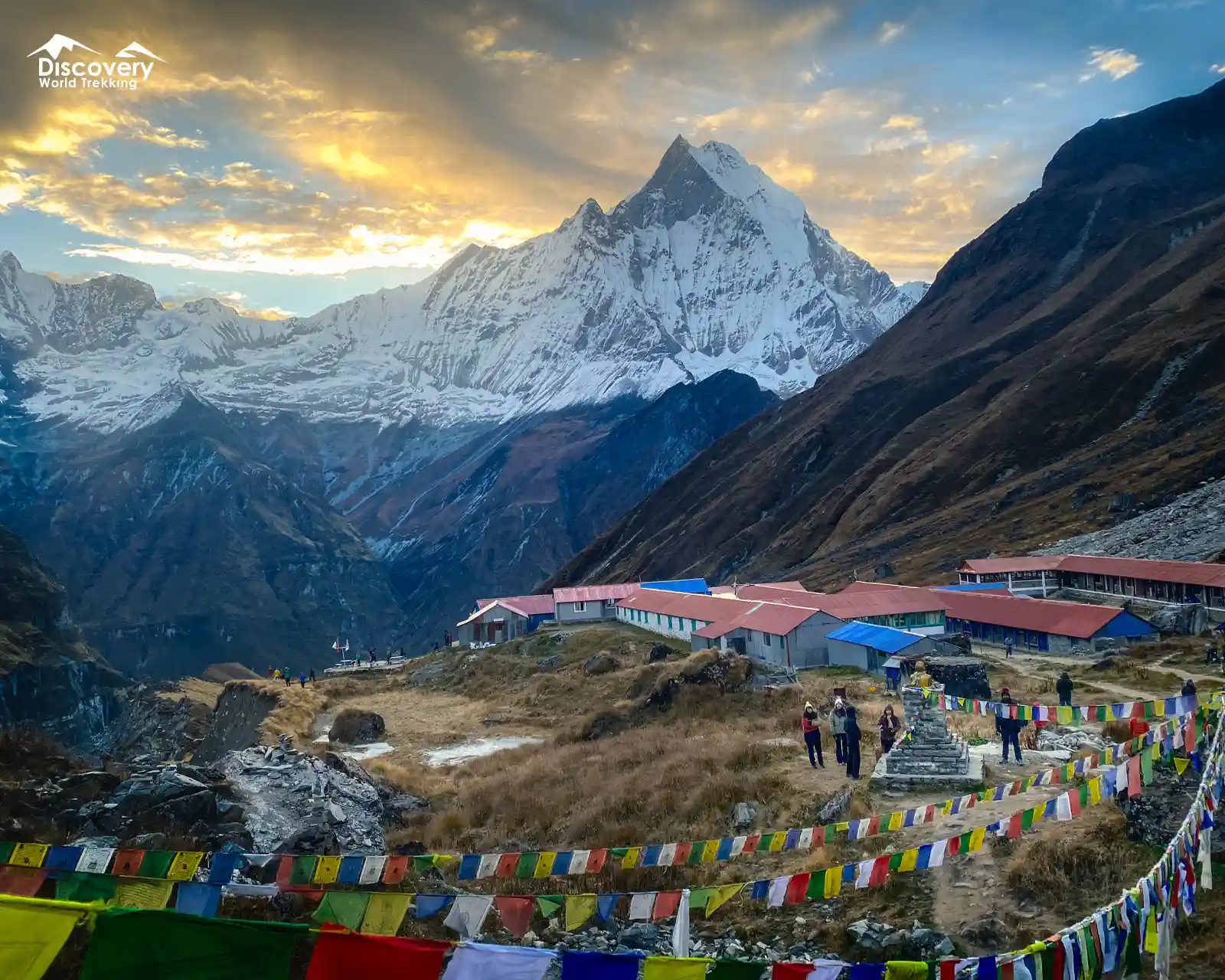
From Machhapuchhre Base Camp, close-range views of Machhapuchhre dominate the valley, while the surrounding peaks of the Annapurna Sanctuary begin to encircle the route. Depending on the weather and group condition, a short rest or light refreshment is taken here before continuing onward.
The final stretch to Annapurna Base Camp takes approximately two hours and involves a gradual but noticeable altitude gain across glacial terrain. Walking conditions remain exposed, and cold temperatures are common, especially in the afternoon with winds. The challenge of this section primarily comes from altitude and environmental conditions rather than distance or technical difficulty.
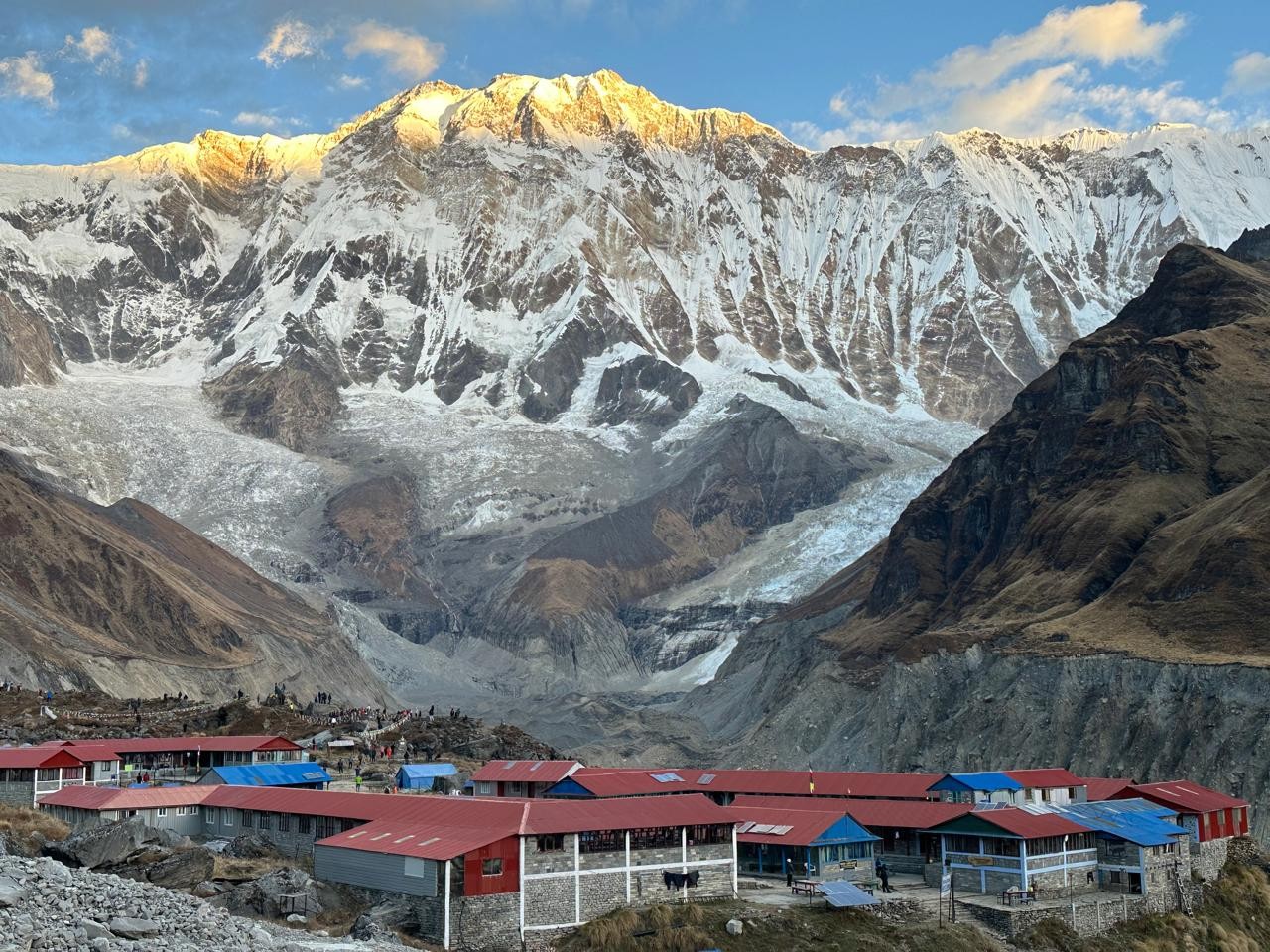
Upon arrival at Annapurna Base Camp, trekkers are surrounded by a natural amphitheater of high peaks, including Annapurna I, Annapurna South, and Hiunchuli, with dramatic close-up mountain walls rising directly from the sanctuary floor. Sunset views are often clear and striking, making the evening at base camp a highlight of the trek. Overnight accommodation is arranged in a pre-booked guesthouse at Annapurna Base Camp.
Stay at Annapurna Sanctuary Guesthouse or similar, depending on availability.
The day begins with a descent from Annapurna Base Camp, retracing the route through Machhapuchhre Base Camp and back into the upper Modi Khola valley. As altitude decreases, the wide alpine basin gradually narrows, and cold, exposed terrain gives way to moraine paths and sheltered walking.
The trail passes through Deurali, Himalaya, and Dovan, with conditions becoming progressively warmer and more forested. While altitude-related fatigue reduces during descent, the long downhill sections place noticeable strain on knees and ankles, making careful foot placement and steady pacing important throughout the day.
Beyond Dovan, the route continues through dense bamboo and rhododendron forests as the landscape fully transitions back to lower-valley terrain. Weather conditions can vary, and the trail may be damp or muddy depending on the season. Our guides manage the pace and rest stops to ensure a controlled, comfortable descent.
By late afternoon, the trail reaches Bamboo, where overnight accommodation is arranged in a pre-booked guesthouse. This marks the end of the high-altitude section of the trek and offers a well-earned rest after a long descent.
Stay at Bamboo Guest House or similar, depending on availability.
The trek begins with a descent from Bamboo through forested trails toward Upper and Lower Sinuwa, gradually losing altitude before reaching the Chhomrong Khola. After crossing the river, the trail climbs steeply back up to Chhomrong, marking the day's most demanding ascent and often the most unexpected for trekkers.
Beyond Chhomrong, the route descends steadily through terraced hillsides and mixed forest toward Jhinu Danda. This section is less strenuous but requires careful footing on stone steps, especially in wet conditions. Overall, the day involves a mix of descent and ascent rather than a continuous downhill walk, so steady pacing is important.
Upon arrival in Jhinu Danda, accommodation is arranged in a pre-booked guesthouse. Later in the afternoon, a 20 to 25-minute downhill walk leads to the natural hot springs beside the Modi Khola. The soak offers welcome relief after several long trekking days, though the return walk back to the lodge involves a steep uphill climb that should be taken slowly.
Stay at Hotel Himalaya in Jhinu Danda or similar, depending on availability.
The trekking portion of the Annapurna Base Camp journey concludes with a short, low-altitude walk from Jhinu Danda to Samrung, the designated road-access pickup point. This final hike follows village paths and riverside trails, including a long, scenic suspension bridge over the Modi Khola. Although relatively easy compared to previous days, the trail remains uneven in places and should be walked with care.
At Samrung, a private jeep arranged by Nepal Hiking Team meets the group for the return drive to Pokhara. The journey takes approximately two to three hours, depending on road and traffic conditions, and marks the end of the trekking section of the trip.
Upon arrival in Pokhara, transfer to a pre-booked lakeside hotel. The remainder of the day is free to rest, enjoy the surroundings, or take a gentle walk along Phewa Lake, offering a comfortable transition back to city life after the trek.
Stay at Hotel Hidden Kingdom in Pokhara or similar, depending on availability.
Today, you return to Kathmandu by comfortable tourist bus, covering approximately 204 kilometres along Nepal’s main highway. The journey takes six to seven hours, depending on traffic and road conditions, with scheduled roadside stops for meals and refreshments. Views along the route include river valleys, terraced hillsides, and rural settlements, with occasional distant mountain scenery when the weather is clear.
Upon arrival in Kathmandu, a Nepal Hiking Team representative will meet you and assist with hotel check-in. Later the same day, you will receive a trek completion certificate issued by Nepal Hiking Team as a memento of completing the Annapurna Base Camp Trek.
Stay at Woodapple Hotel and Spa or a similar
After breakfast at the hotel, you will prepare for your international departure, marking the completion of your 14-day Annapurna Base Camp trek with Nepal Hiking Team.
A representative from Nepal Hiking Team will transfer you to Tribhuvan International Airport (TIA) at least 3 hours before your scheduled flight, allowing sufficient time for check-in and departure procedures.
With photographs, shared moments, and lasting memories from the Annapurna region, you will bid farewell to Nepal and conclude your Himalayan journey.
Cost Incudes/Excludes
Cost Includes
- In Kathmandu: Two nights of twin-sharing/double accommodation at a 3-star hotel in Kathmandu with (e.g., Woodapple Hotel and Spa or similar)
- In Pokhara: Two nights of twin-sharing/double accommodation at a 3-star hotel in Pokhara with breakfast
- During the ABC Route: Lodge accommodation on a twin-sharing basis up to Chhomrong; beyond Chhomrong, rooms are typically dormitory-style, shared by 3–4 trekkers due to limited availability at higher elevations.
- Full board meals during the 9-day trek: breakfast, lunch, and dinner (Vegan, Vegetarian, and Gluten-free meals available.)
- Tea or coffee served with all meals (up to three cups per day)
- Breakfast is included at hotels in Kathmandu and Pokhara
- All airport transfers (both arrival and departure) are provided in a private vehicle.
- Surface transfers between Kathmandu and Pokhara via a tourist bus (flight upgrade available at an additional cost of USD 115 for one way)
- Private vehicle transfers from Trek starting and ending Points: Private vehicle transfers from Pokhara and Birethanti, and a private jeep transfer from Jhinu Jeep Station (Samrung) to Pokhara.
- One trained and experienced, English-speaking, government-licensed trekking guide
- One porter for every two trekkers (each porter carries up to 25 kg total—approx 12–13 kg per trekker)
- Wages, accommodations, meals, equipment, insurance, and medical coverage for all field staff
- A comprehensive medical kit (oximeter and Diamox included) carried by your guide
- Annapurna Conservation Area Permit (ACAP).
- Use of an NHT down jacket and a four-season sleeping bag during the trek (to be returned after the trip)
- One duffel bag (70 L) per participant
- Nepal Hiking Team t-shirt, cap, and Annapurna Base Camp trekking map
- All applicable government and local taxes and administrative service charges
Cost Excludes
- Meals not specified in the 'Meal Inclusions' section
- Travel Insurance
- International airfare
- Nepal entry visa fees
- All kinds of cold drinks, including water, coke, Fanta, juice, etc.
- Wi-Fi internet during the trek
- Personal trekking equipment
- Tips for airport representatives, tour guides, trekking staff, drivers, etc.
FAQs
Yes, travelers from most countries can obtain their visas upon arrival at Tribhuvan International Airport. To make things smoother, fill out the online application form before you travel and bring either cash or a card to pay the visa fee. Make sure your passport won’t expire for at least 6 months after you arrive in Nepal, and check that you have an empty page for the visa stamp.
Yes, we arrange both airport pickup and drop-off for everyone booking the Annapurna Base Camp Trek. When you arrive, one of our team members will be waiting outside the airport holding a “Nepal Hiking Team” sign so you can easily spot them.
At the end of your trip, we’ll return you to the airport three hours before your departure. If your plans change and you arrive early or wish to stay longer in Nepal, we’re flexible and can accommodate your updated schedule.
Your package includes a stay at a 3-star hotel in Thamel, such as the Woodapple Hotel & Spa, which is included with your Annapurna Base Camp Trek booking.
If you prefer something more luxurious, we can arrange an upgrade to a 4-star or 5-star property as per your needs. Please note that upgrading will incur an additional cost, and the price varies depending on the specific hotel you select.
An extra night costs USD 45 for a single room or USD 50 for a twin or double room, inclusive of breakfast and all applicable taxes. If you’d like to arrive a day early or stay longer after your trek concludes, please let us know, and we’ll be happy to assist with your booking arrangements.
During the pre-trek briefing in Kathmandu, Nepal Hiking Team ensures you are fully prepared and confident before your journey begins. At this meeting, you will be introduced to your guide, who will accompany and support you throughout the trek. We will also collect your passport and a copy of your travel insurance for permit processing and safety records. If you have any remaining balance for the trek, it will be settled now.
Our guide will inspect your equipment to ensure you have everything necessary for a safe and comfortable experience. We will also provide you with essential trekking gear, including a down jacket, sleeping bag, cap, hat, a detailed Annapurna Base Camp Trek map, and a duffel bag for your belongings. The briefing is also your opportunity to ask any last-minute questions, clarify details, or share any concerns with our team.
Map