Overview
Greetings of the Day!!
Based on your provided requirements, we are pleased to offer you the following quote for an unforgettable India Tour experience.
We are Global Rising Tours and Travels, one of the best tour operators in Nepal, proudly serving travelers since 2010. With over a decade of experience, we specialize in crafting memorable journeys that blend adventure, culture, and comfort, ensuring an exceptional travel experience for our valued guests.
Outline Itinerary
You are transferred from your hotel in Kathmandu to the domestic terminal for the short flight to Bhairahawa - Gautam Buddha International Airport - in the western Terai, around thirty-five minutes. A road transfer is available as an alternative.
From Bhairahawa a vehicle takes you the short distance south to the Sunauli border crossing, one of the main land routes between Nepal and India. Immigration formalities are completed on both sides; Indian visas must be arranged well in advance and cannot be obtained at the border.
Lumbini, the birthplace of the Buddha and a UNESCO World Heritage site, lies close to Bhairahawa and can be visited before crossing if the schedule allows - the Maya Devi temple, the Ashokan pillar and the surrounding monastic zone are all worth an hour or two.
Once across, the drive continues into Uttar Pradesh towards Gorakhpur, with the landscape flattening into the intensively farmed plains of the Gangetic basin.
Total travel time varies with the border queue. Overnight in Gorakhpur.
The morning is given to the Gorakhnath Temple, the seat of the Nath monastic order and the temple from which the city takes its name. It is an active and busy complex dedicated to Guru Gorakhnath, and the atmosphere - particularly during morning aarti - is very different from a monument visited as a tourist site.
From Gorakhpur you travel south to Varanasi, around five to six hours by road or by train depending on the schedule.
Varanasi is among the oldest continuously inhabited cities in the world and the holiest city in Hinduism, believed to be founded by Shiva. For Hindus, dying here and being cremated on the ghats brings moksha - release from the cycle of rebirth - and the city is organised around that belief in a way that can be confronting for first-time visitors.
In the evening you attend the Ganga Aarti at Dashashwamedh Ghat, a highly choreographed fire ceremony performed nightly by young priests with brass lamps, bells and incense. It is best watched from a boat on the river, which we arrange.
Overnight in Varanasi.
A pre-dawn start for a boat trip on the Ganges as the sun rises. This is the essential Varanasi experience: the ghats coming to life along four miles of riverbank, pilgrims performing ritual bathing and sun salutations, laundry being beaten on the steps, and the smoke rising from the cremation ghats at Manikarnika and Harishchandra.
Photography is permitted along the river but never at the cremation ghats themselves, and your guide will be clear about where to put the camera away.
After breakfast there is time to walk the narrow lanes of the old city to the Kashi Vishwanath Temple, one of the twelve Jyotirlingas and the most sacred Shiva temple in India, recently expanded through a large corridor project connecting it to the river.
Sarnath, ten kilometres away, is where the Buddha delivered his first sermon after enlightenment, and the Dhamek Stupa and archaeological museum there are worth the detour.
In the afternoon you drive north-west to Ayodhya, around four to five hours. Overnight in Ayodhya.
Ayodhya, on the banks of the Sarayu river, is revered in Hindu tradition as the birthplace of Rama and one of the seven sacred cities of Hinduism.
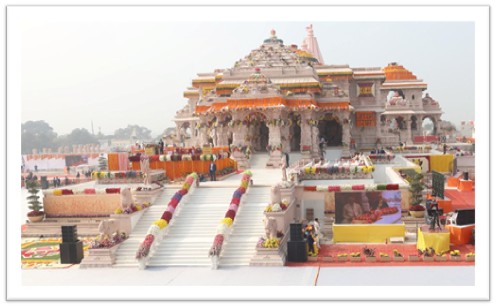
The morning is spent visiting the Ram Janmabhoomi temple, consecrated in 2024 and now among the most visited pilgrimage sites in India, along with Hanuman Garhi, a fortress-like temple on a mound reached by seventy-six steps, and the Kanak Bhawan, said to have been given to Sita by Kaikeyi. Security at the main temple is tight and bags, phones and cameras are generally not permitted inside.
Ram ki Paidi, the series of ghats along the Sarayu, is worth seeing in the early morning or at dusk.
After lunch you drive to Lucknow, around two and a half hours. The capital of Uttar Pradesh is known for its Nawabi heritage, its Awadhi cuisine - this is the home of galouti kebab and dum biryani - and its chikankari embroidery. If time allows, the Bara Imambara with its extraordinary labyrinth and the Rumi Darwaza gateway are the highlights.
In the evening you board the overnight train to Jaipur. Overnight on the train.
You arrive in Jaipur in the morning and transfer to your hotel to freshen up before the day's sightseeing.
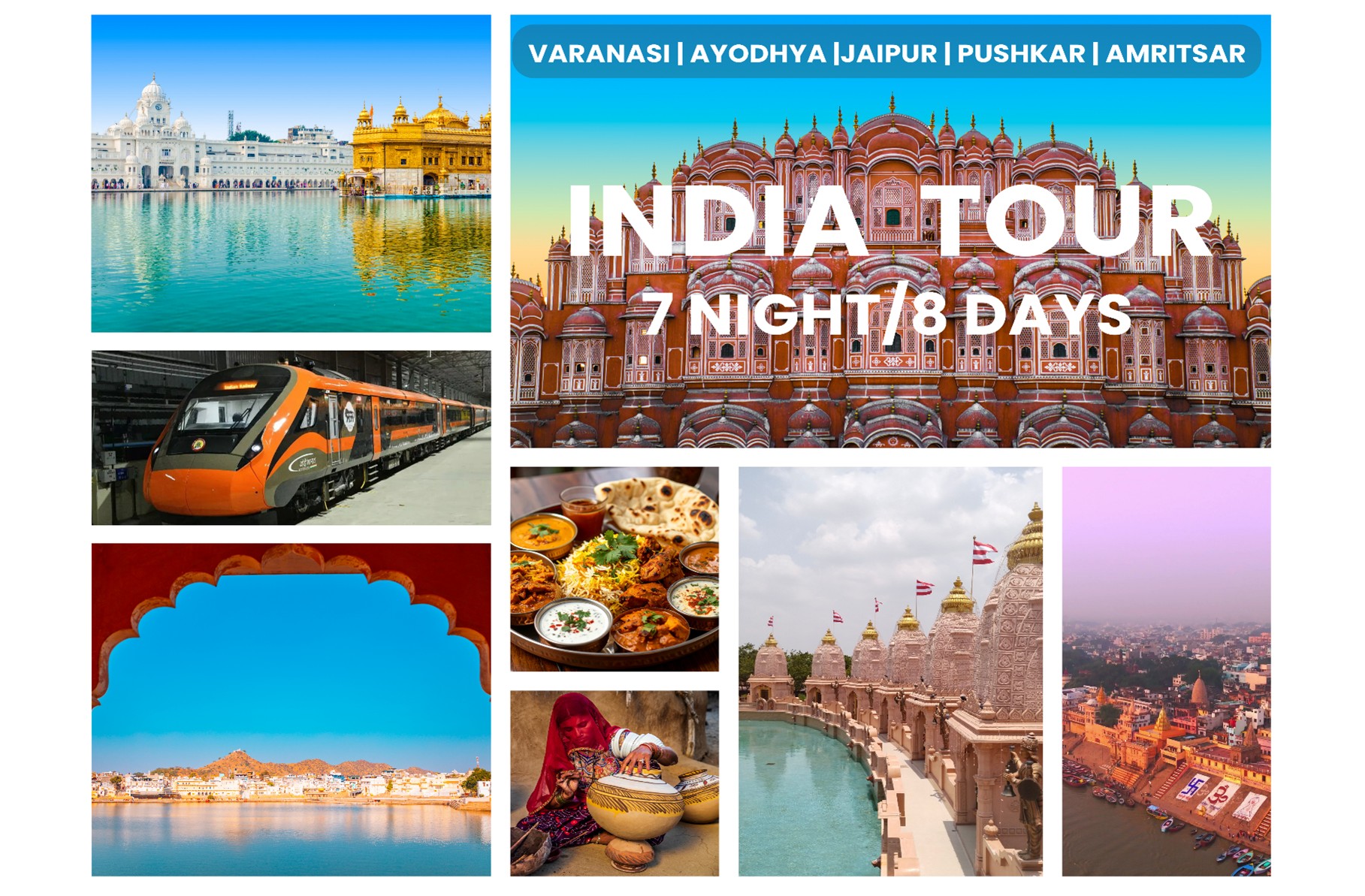
Jaipur, the capital of Rajasthan, was founded in 1727 and is known as the Pink City for the terracotta colour applied to the old town in 1876 to welcome the Prince of Wales. The walled city is a UNESCO World Heritage site and was laid out on a strict grid according to Vastu Shastra principles.
The day covers the Hawa Mahal, the five-storey honeycomb facade of 953 windows built so that royal women could watch street processions unseen; the City Palace complex, still partly the residence of the royal family, with its textile and armoury museums; and the Jantar Mantar, an eighteenth-century astronomical observatory of monumental stone instruments, including the world's largest stone sundial.
The Amber Fort, on a ridge outside the city, is the other essential site - a hilltop palace complex of courtyards, the mirrored Sheesh Mahal, and long fortified walls running along the ridge.
Overnight in Jaipur.
An early drive to Pushkar, around two and a half hours south-west of Jaipur, one of the oldest cities in India and a major Hindu pilgrimage centre.
Pushkar is built around a sacred lake said to have formed where Brahma dropped a lotus flower, and it holds one of the very few temples to Brahma anywhere in the world. Fifty-two ghats surround the lake, and pilgrims bathe here particularly during Kartik Purnima. The town is vegetarian and alcohol-free by custom, and the bazaar around the lake is good for textiles, silver and leather.
If your visit coincides with November, the Pushkar Camel Fair is one of the largest livestock fairs in the world and an extraordinary spectacle.
From Pushkar you continue the short distance to Ajmer to visit the Ajmer Sharif Dargah, the shrine of the Sufi saint Moinuddin Chishti and one of the most important Islamic pilgrimage sites in South Asia, visited by Muslims and Hindus alike.
In the evening you board the train to Amritsar. Overnight on the train.
You arrive in Amritsar in Punjab and transfer to your hotel.
The Golden Temple - Harmandir Sahib - is the holiest site in Sikhism and the reason most visitors come. The gilded sanctum sits in the middle of a large tank of water, reached by a causeway, with continuous recitation of the Guru Granth Sahib audible across the complex. Heads must be covered and shoes removed, and coverings are available at the entrance.
The langar, the free community kitchen attached to the temple, serves upwards of fifty thousand meals a day to anyone who comes, prepared and served entirely by volunteers. Visitors are welcome to eat and, if they wish, to help.
Jallianwala Bagh, immediately beside the temple, is the walled garden where British troops fired on an unarmed gathering in 1919; the bullet marks are preserved in the walls.
In the late afternoon you drive to the Wagah border for the daily flag-lowering ceremony, an elaborately theatrical piece of military drill performed simultaneously by Indian and Pakistani forces before large crowds on both sides. Overnight in Amritsar.
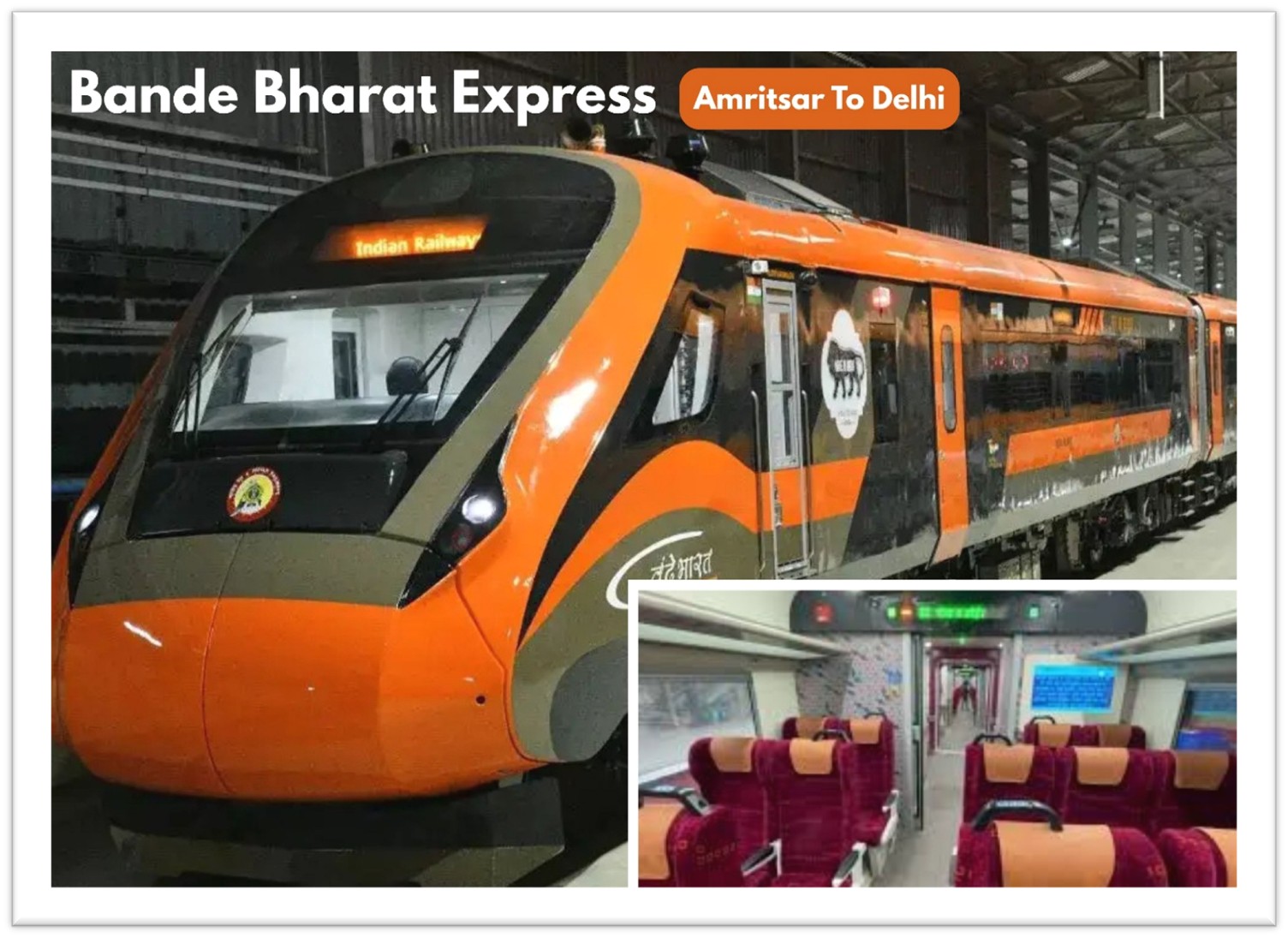
An early morning express train from Amritsar to Delhi, around six hours, running through the agricultural heartland of Punjab and Haryana.
On arrival in Delhi you are met at the station. Depending on your flight time there may be several hours available, in which case a short tour can be arranged - India Gate, Rashtrapati Bhavan and Connaught Place are all close to the centre, and Chandni Chowk in Old Delhi is the place for a last meal.
Day-use of a hotel room can be arranged so you have somewhere to shower and repack before the airport, which after a week of travel and two overnight trains is worth considering.
You are transferred to Indira Gandhi International Airport approximately three hours before your evening flight to Kathmandu, around one hour forty minutes in the air.
You are met at Tribhuvan International Airport on arrival and transferred onward. The tour ends in Kathmandu.
Cost Incudes/Excludes
Cost Includes
- Kathmandu Bhairawaha Flight Ticket
- Delhi to Kathmandu Flight ticket in Economic class
- All Hotel Accomodation in double and triple sharing basis on Map Plan
- Lunch at indian restaurant and some dinner at train as per irtinerary
- Professional Tour Guide
- Train ticket-as per itinerary
- Mineral water during the trip
- All tour and transfer by Sutlej bus and Traveller van or rikshaw
- Hotel Taxes
- All entry fees and government taxes during the trip
Cost Excludes
- Personal expenses such as laundry, phone calls, and beverages.
- Travel insurance and medical expenses.
- Camera/video fees at monuments and parks.
- Tips and gratuities for guides, drivers, and hotel staff.
- Any additional meals, snacks, or drinks not mentioned in the inclusions.
- Expenses incurred due to unforeseen events such as flight delays, natural calamities or political disturbances.
- Any optional activities, excursions, or sightseeing not mentioned in the itinerary.
- *most of the food will be veg please be noted.